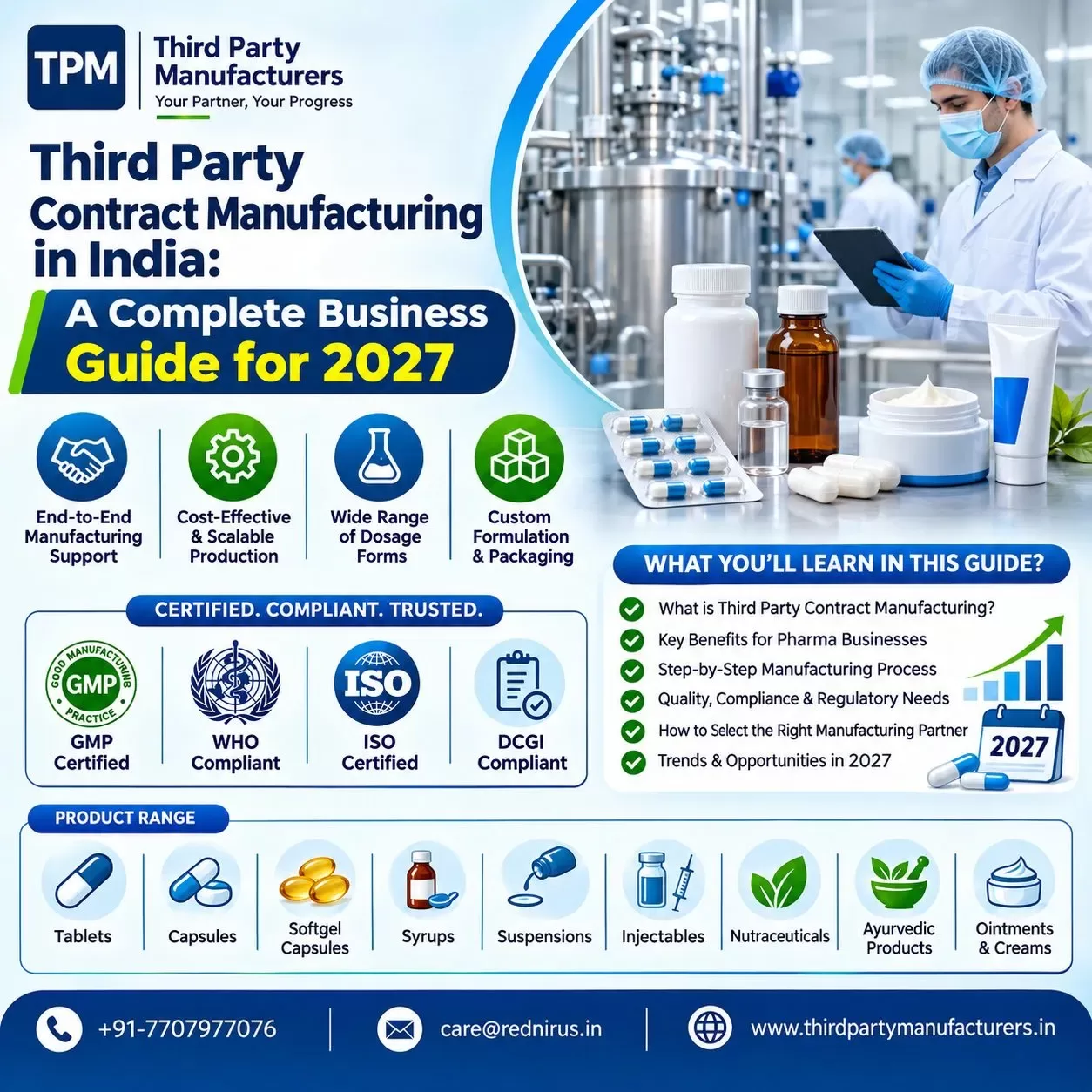
Third party contract manufacturing in India is the most realistic option for entrepreneurs as well as existing brands who wish to manufacture and introduce pharmaceutical products in India without establishing their own plant. Rather than spending crores of rupees on machinery, clean rooms and regulatory personnel, the brand owner can simply get their manufacturing done from a registered plant and focus only on marketing and sales. Given the stricter quality standards, growing need for exports, and competitive domestic industry, now is the ideal time for you to understand and prepare this business model.
What is Third Party Contract Manufacturing in India and How Does It Work?
Here, one entity has control over the brand name, formulae, and marketing of the products, whereas another entity, having the legal permit to manufacture, will manufacture the product on behalf of the other. The product will be manufactured in the manufacturer’s facility, will be packed under the brand name and transported either to the warehouse of the brand owner or directly to the distributor.
Third Party Contract Manufacturing in India involves clear delineation of responsibilities. Here, the brand owner provides the list of the product, strengths, packaging specifications and trademark. On the other hand, the manufacturer provides the procurement of raw materials, formulation, in-process quality checks, packaging, batch records and release testing. Pharmaceutical contract manufacturing includes tablets, capsules, syrup, injection, ointment, dry powder, and nutraceuticals or herbal forms of the product.
Two such models can be found in consideration. In one model, the brand company will select formulations out of the available formulations by the manufacturer and purchase on a batch-by-batch basis. In the second model, the brand company offers the formulations to the plant, and then after technology transfer, validation, and stability testing, the production starts. Another significant difference between the manufacturing of pharmaceutical contract manufacturing from ordinary trade is that the responsibility for Good Manufacturing Practice belongs to the plant, while the responsibility for making claims, pricing, pharmacovigilance, and distribution belongs to the brand owner.
The franchisees, hospitals, exporting companies, and startups use this method of entry as this makes their investment in fixed assets as operating expenses. The Pharma Third Party Manufacturing Company can serve more than one client through one plant location.
Why Pharma Contract Manufacturing Companies Are Growing Fast in 2027?
India has an extensive infrastructure of formulation facilities, qualified scientists and API manufacturers, and provides a significant portion of the world’s generic medicines in volume terms. This environment makes Third Party Contract Manufacturing in India appealing for emerging and established companies alike, and is the reason why Third Party Pharma Manufacturing is continuously growing in therapy categories.
There are several factors pushing this demand this year:
- Financial pressure. Any formulation facility that can be considered flexible needs land, utilities, water, HVAC, quality control laboratories and validation facilities. The majority of new companies do not have sufficient capital to invest in all of these.
- Increase in regulation. The changed version of Schedule M requires special in-house facilities that many small companies prefer outsourcing instead of upgrading their facilities.
- Speed to market. With a ready-made facility, a company can go from product selection to launch in months.
- Expansion of product categories. Companies already existing in the market can add additional lines of derma, gynae, critical care, veterinary or nutraceutical items without investing in any new lines.
- Export focus. If you want to export to Africa, Southeast Asia and Latin America your facility must be WHO-GMP compliant.
Therapy segments with strong outsourcing demand include derma, gynae, cardiac-diabetic, paediatric, orthopaedic and veterinary ranges. In these segments, brands are competing based on product variety, market coverage and service instead of possession of this facility, thus highlighting the importance of the partner’s manufacturing capacities instead of ownership of the factory.
Contract Manufacturing Companies benefit from high level production capacity as well, because planned and steady volumes increase production efficiency. When both parties sign a clear contract, the partnership becomes a long-term and reliable affair instead of a one-time company transaction.
How to Choose Among Pharmaceutical Contract Manufacturing Companies in India?
Partner selection is the critical step in Third Party Contract Manufacturing in India because the quality of the product, delivery time and regulatory compliance all hinge upon that. In selecting between Pharmaceutical Contract Manufacturing Companies, look into these factors before you begin price discussions.
- License and Approvals: Seek certification of the current manufacturing license from the State Drug Control authority, the approved product list and their respective doses, and any WHO-GMP certificate. It should be ascertained that the appropriate forms have been approved for use at that particular site.
- Plant and Equipment: Visit the manufacturing site. Assess area segregation, clean room classification, calibration documentation, water system maintenance and the status of packaging lines.
- Quality System: A dependable list of Pharma Contract Manufacturing Companies will include those who have a Quality Assurance department, SOPs, stability program and retained samples. Determine how deviations and out-of-specification results are communicated.
- Testing: On-site laboratory with HPLC, dissolution, and microbiology testing saves time and money of outsourcing testing.
- Experience: Ask for references, audit reports, and complaint history. Multiple repeat orders reflect the reliability of performance.
- Terms of business: Compare the minimum order quantity, batch size, delivery period, availability of packing materials, payment terms, and revision of prices. The lowest quotation can be a sign of poor quality raw materials and lack of testing.
- Confidentiality: Your formulas, artwork, and trademark should be covered by the contract and exclusivity of your product should be mentioned.
Regulatory and Quality Requirements in Pharmaceutical Third Party Manufacturing
The scope of Pharmaceutical Contract Manufacturing comes under the purview of the Drugs and Cosmetics Act, 1940, its rules and directions of the CDSCO and state licensing agencies. There should be clarity on the part of each party regarding its jurisdiction.
- Manufacturing license: The manufacturing unit must have license for all the dosage forms and manufacture only those products which have been issued licenses. License for the manufacture of new pharma products needs special permissions.
- License for loans and marketing: In case the brand has no manufacturing unit, then the license of the manufacturer or loan license system is followed. Some other licenses such as wholesale drug license, GST license and registered trademark license may be required based on the state.
- GMP Compliance: Revised Schedule M pays importance to quality risk management, pharmaceutical quality systems, product quality reviews, qualification and validation and computerized systems. Check the GMP compliance status of your partner and if gap assessment is done or not.
- Price control: Formulations coming under Drugs (Prices Control) Order will need to adhere to NPPA ceiling price; hence, check whether the formulation is under schedule.
- Labelling and claims: Label must have all the necessary information like manufacturing detail, batch number, expiry date, composition and warnings. Nutraceutical and herbal products may be governed by FSSAI or AYUSH.
- Agreement on quality: It should be stated in a written agreement who releases batches and who will recall the products.
Third Party Manufacturing Pharma Company that considers compliance as something to be practiced every day rather than something to be done before an inspection is much more trustworthy.
Costs, MOQ and Planning Your Third Party Pharma Manufacturing Business
Third Party Pharma Manufacturing budgeting is not just about the unit price. Plan for Product Development/formulation transfer, trial manufacturing, artwork and packaging design, trademark/license registration, stability testing (where needed), transportation, storage, and promotion. Price will be based on the formulation, raw materials quality, pack type, and quantity ordered.
The MOQ varies depending on the dosage form. Tablet and capsule products are generally produced in larger quantities compared to syrup, while injection and other specialized products may require larger orders due to setting up and sterility testing. Get from each manufacturer the batch sizes, MOQ per product, packing material MOQ, and have written quotes only.
A practical launch plan for Third Party Contract Manufacturing in India looks like this:
- Select one focus area such as derma, gynae, cardiac-diabetes, pediatric or veterinary and analyze the competitor pricing in this area.
- List three to four vendors for audit and sample ordering.
- Conclude the contract, quality specifications and artwork.
- Clear trademark and license issues.
- Market with a few product lines and expand only after receiving second orders to show demand.
Arrange payment and delivery schedule as per your own cash flow cycle. A big launch order may create financial problems much before second-order starts coming, so arrange first order schedule carefully.
Brand owners should establish their own pharmacovigilance system and maintain dispatch details batch-wise so that any recall can be done easily.
Frequently Asked Questions
Q1. What is Third Party Contract Manufacturing of Pharmaceuticals in India?
It refers to a licensed pharmaceutical manufacturing unit making products for the brand of another entity. The brand owner will be responsible for marketing and distribution, while the manufacturer will take care of manufacturing, testing and packaging.
Q2. How do I choose the right Pharmaceutical Contract Manufacturing Companies?
First, verify their licences, WHO and GMP certification and product approvals. Then visit the facility, check laboratory capacity and ask for references from previous clients. Compare their MOQ, lead time and contract terms before signing up.
Q3. Is it necessary to have my own plant for Third Party Manufacturing of Pharmaceuticals?
No, the other party’s licensed plant manufactures the products for you. You may still require registration of a trademark, GST and possibly a wholesale drug license.
Conclusion
Third Party Contract Manufacturing in India offers fresh or existing brands an easy way to enter the pharmaceutical market if they make proper partner selection and take quality and compliance as collective duties. The companies that will flourish by 2027 will check the licenses, audit plants, record contracts, and start with a concentrated portfolio. No matter whether you are a PCD franchisee or exporting company or a startup, Pharmaceutical Contract Manufacturing helps you convert manufacturing from an obstacle to a service. Be careful about doing your due diligence, request proof of everything, and cultivate a relationship with a manufacturer who sees your brand as their brand.
Must Read: 10 Reasons to Outsource Third Party Drug Manufacturing in India
How does third party contract manufacturing in India work?
Third party contract manufacturing in India is by far the most realistic option for entrepreneurs as well as existing brands who wish to manufacture and introduce pharmaceutical products in India without establishing their own plant. What is Third Party Contract Manufacturing in India and How Does It Work?
Third party contract manufacturing in India is by far the most realistic option for entrepreneurs as well as existing brands who wish to manufacture and introduce pharmaceutical products in India without establishing their own plant. Rather than spending crores of rupees on machinery, clean rooms, and regulatory personnel, the brand owner can simply get their manufacturing done from a registered plant and focus only on marketing and sales. Given the stricter quality standards, growing need for exports, and competitive domestic industry, now is the ideal time for you to understand and prepare this business model. What is Third Party Contract Manufacturing in India and How Does It Work?
Key takeaways
- Third party manufacturing lets you sell under your own brand without owning a unit
- Choose WHO-GMP certified manufacturers with the right product permission
- Compare MOQ, per-unit rate and first-batch lead time in writing
By the numbers
- India is the largest provider of generic medicines globally — IBEF
- India has the highest number of US-FDA compliant manufacturing facilities outside the United States — Invest India, Government of India
How to order Third Party Contract Manufacturing in India: A Complete Business Guide for 2027
- Define the product Fix the composition, dosage form, pack size, quantity and your brand name.
- Shortlist manufacturers Compare WHO-GMP certification, product permission, capacity and location.
- Compare quotations Ask for the per-unit rate, MOQ, lead time and packing material cost in writing.
- Approve artwork and sample Finalise label, carton and MRP, and approve the pre-production sample.
- Receive your batch Pay the agreed advance and receive goods with invoice and certificate of analysis.