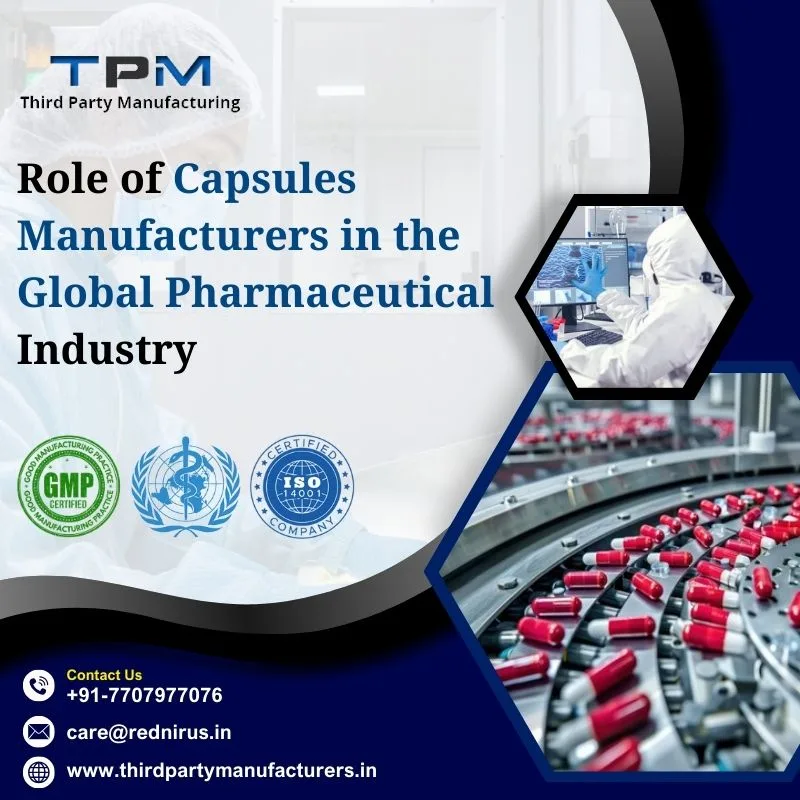
Pharma is one of the biggest industries on the planet, with thousands of companies turning out drugs of every kind. Of all the ways to deliver a medicine, the capsule is among the most common and the most effective. Patients find it easy to swallow, the dose is accurate, and it often holds up better on the shelf than other forms like the tablet. Behind every strip of capsules are capsules manufacturers whose work quietly shapes the global pharma market. This post looks at what they do and how it helps people's health around the world.
Understanding the Role of Capsules Manufacturers
A capsule holds a drug in powder or liquid form, sealed inside a thin shell that is designed to open only once it gets where it needs to be. You swallow it, it dissolves in the stomach, and the medicine inside is released for the body to absorb. Capsules manufacturers have the job of producing them in huge numbers while sticking to strict safety rules and to the exact formula each pharma client asks for.
- Formulation and Design: Different medicines need different capsules. Makers develop shells with different release patterns, extended-release and delayed-release among them, for conditions where the drug has to come out slowly or in a controlled way.
- Quality Control and Compliance: Every capsule must meet regulatory standards on safety and efficacy. Plants run tough checks during production so that each batch matches its specifications on size and weight, with the content uniform from the first capsule to the last. Get these wrong and the patient gets the wrong dose.
- Production efficiency: Global demand keeps climbing, so big producers have to run large volumes without letting quality slip. Advanced Third Party Manufacturing methods and automated lines raise output and cut production costs.
- Research and Development: Capsule makers often work alongside pharma companies at the R&D stage. They try out new formulations and study how well a drug is absorbed, then build capsules for specific treatment needs. Many new medicines simply wouldn't get made without them.
How Capsule Manufacturing Companies Contribute to Pharmaceutical Success?
Regulators approve a product only if it meets set requirements for quality and safety. So capsule plants must work to those standards, or the medicine never reaches a patient. They make capsules for both generic and branded drugs.
Over time they've learned to produce capsules in many sizes and types, with different coatings, and to match each one to what the medicine is for, the dose it carries and the kind of patient who will take it. Extended-release capsules are one example. Softgel products and vegetarian shells are others.
Capsule makers also help build new drug formulations. They sit with pharma companies to design capsules for new drug types or to take advantage of better medical technology. That's one way new treatments move forward and reach the chemist's shelf, and it's work that rarely gets noticed outside the trade even though so much depends on it.
The Growing Demand for Capsule Contract Manufacturing
Capsule contract manufacturing is one of the clearest trends in pharma right now. Plenty of companies would rather hand capsule production to a specialist than run it themselves. They save on production costs, get access to modern technology, and keep their own money and people on drug development and marketing.
The arrangement is simple, and most first-time brand owners pick it up within a single meeting with the plant. The pharma company gives the formula; the contract plant makes capsules to that spec. No need to invest in your own buildings or machinery, and much of the compliance burden sits with the plant. You get the benefit of their experience in making good capsules, and your own operations stay much less complicated.
Advantages of Capsule Manufacturing for Pharmaceutical Companies
Pharma Capsule Manufacturing brings a lot to the table. Versatility is the main reason companies pick capsules over other dosage forms. The key advantages:
- Rapid Dissolution: A capsule breaks down quickly in the stomach, so the active ingredient gets absorbed faster.
- Improved Bioavailability: Some drugs absorb better inside a capsule, which shields them from digestive enzymes and helps them reach the bloodstream.
- Accurate Dosage: Each capsule can carry an exact dose. Every one delivers the same amount.
- Variety: Plants can make several types, such as extended-release and delayed-release capsules, to fit particular treatment needs.
Capsules are also easier to swallow than a tablet for many people, particularly those who struggle with pills. That's why doctors often prefer them for children and elderly patients. Demand rises.
Impact of Pharmaceutical Capsule Manufacturers on Drug Development
Pharma never stands still. Research labs keep going. New treatments for all sorts of diseases are always in the works, and capsule manufacturers are part of that effort, working with drug developers to design capsules that release new medicines properly.
Take newer biological drugs. Many need a particular capsule formulation to stay stable and reach the body intact. Specialists develop coatings that protect the drug from light and moisture, and from air too. Without that work, a lot of advanced medicines would never reach patients.
Capsules also suit drugs that need controlled release. For chronic conditions, where a patient needs a steady dose over hours, controlled-release capsules are a big help. The people who make them make sure the right dose goes in at the right time.
Challenges faced by Capsule Manufacturing Companies
For all the importance of Capsule Manufacturing Companies, their work isn't easy. Demand keeps rising, so they have to keep upgrading processes to stay efficient without hurting quality. Strong demand for particular types, softgel and vegetarian capsules especially, puts extra pressure on them.
Consistency is the hardest part. It always has been. Each capsule must match the next in size and shape, and in weight, and that takes precise control. Even small variations can affect how well the medicine works or make accurate dosing difficult.
Then there are the regulations, which keep changing. Drug laws are strict. They also change often. Plants have to track every change in standards and keep investing in quality systems and staff training as well as technology.
Future Trends in Capsule Manufacturing
The industry keeps expanding, and capsule production should see major developments over the next few years. Demand is rising for special types: capsules for personalised medicine, capsules that release a drug in a specific part of the gut, and capsules that deliver more than one ingredient at once.
Expect more capsule contract manufacturing as more pharma companies move production outside their own walls. Closer work between capsule makers and drug companies should bring more new formulations and better ways of working.
Sustainability matters more now too. Companies are looking at alternatives to gelatin, such as plant-based and vegetarian capsules. As the industry pushes for greener practices, capsule makers will have to keep innovating for patients and for the environment.
Conclusion
Capsules manufacturers have a very big part to play in global pharma. They supply efficient drug delivery systems and work with drug companies on new medicines. As the industry grows, their contribution is hard to overstate. Capsule contract manufacturing will stay central to producing medicines efficiently for patients all over the world.
With higher standards and better processes, and a close eye on new trends, these manufacturers will keep leading the way, so that millions of people everywhere get medicines that are safe and effective, including newer ones that weren't possible a few years back.
You may also Read
What is the role of capsules manufacturers in the global pharmaceutical industry?
The pharma industry is perhaps the largest and most critical industries in the world, with thousands of companies manufacturing many drugs. Among these modes of drug delivery systems, capsules are probably one of the most commonly used and effective ways to take medicine.
The pharma industry is perhaps the largest and most critical industries in the world, with thousands of companies manufacturing many drugs. Among these modes of drug delivery systems, capsules are probably one of the most commonly used and effective ways to take medicine. Capsules are widely adopted as they are easy to swallow, ensure proper dosages, and have better stability compared to other forms in the market, such as tablets. Behind these advantages lie the dedicated capsule manufacturers and companies engaged in capsule manufacturing and a significant role in shaping the global pharmaceutical market. In this blog, let’s talk about their role in the pharmaceutical industry and how it he...
Key takeaways
- Understanding the Role of Capsules Manufacturers
- How Capsule Manufacturing Companies Contribute to Pharmaceutical Success
- The Growing Demand for Capsule Contract Manufacturing
- Impact of Pharmaceutical Capsule Manufacturers on Drug Development
- Challenges faced by Capsule Manufacturing Companies
- Future Trends in Capsule Manufacturing
How to order Role of Capsules Manufacturers in the Global Pharmaceutical Industry
- Define the product Fix the composition, dosage form, pack size, quantity and your brand name.
- Shortlist manufacturers Compare WHO-GMP certification, product permission, capacity and location.
- Compare quotations Ask for the per-unit rate, MOQ, lead time and packing material cost in writing.
- Approve artwork and sample Finalise label, carton and MRP, and approve the pre-production sample.
- Receive your batch Pay the agreed advance and receive goods with invoice and certificate of analysis.